
How to use it
- 1Enter your company name, address and logo once. They are saved on your device for next time, along with who signs.
- 2Fill in the employee's name, ID, designation and department.
- 3Write what happened as plain facts: dates, times, places and what was done. Choose whether the subject line names it, such as 'Absence without permission'.
- 4Give the date by which the written explanation must reach you, and choose what else to say: a hearing in person, what happens if there is no reply, and a line for the employee to sign as received.
- 5Check the preview, press Download PDF / Print, sign it and hand it over. Keep a copy with the employee's signature, or a note of when and how it was given.
Show Cause Notice – a filled-in sample
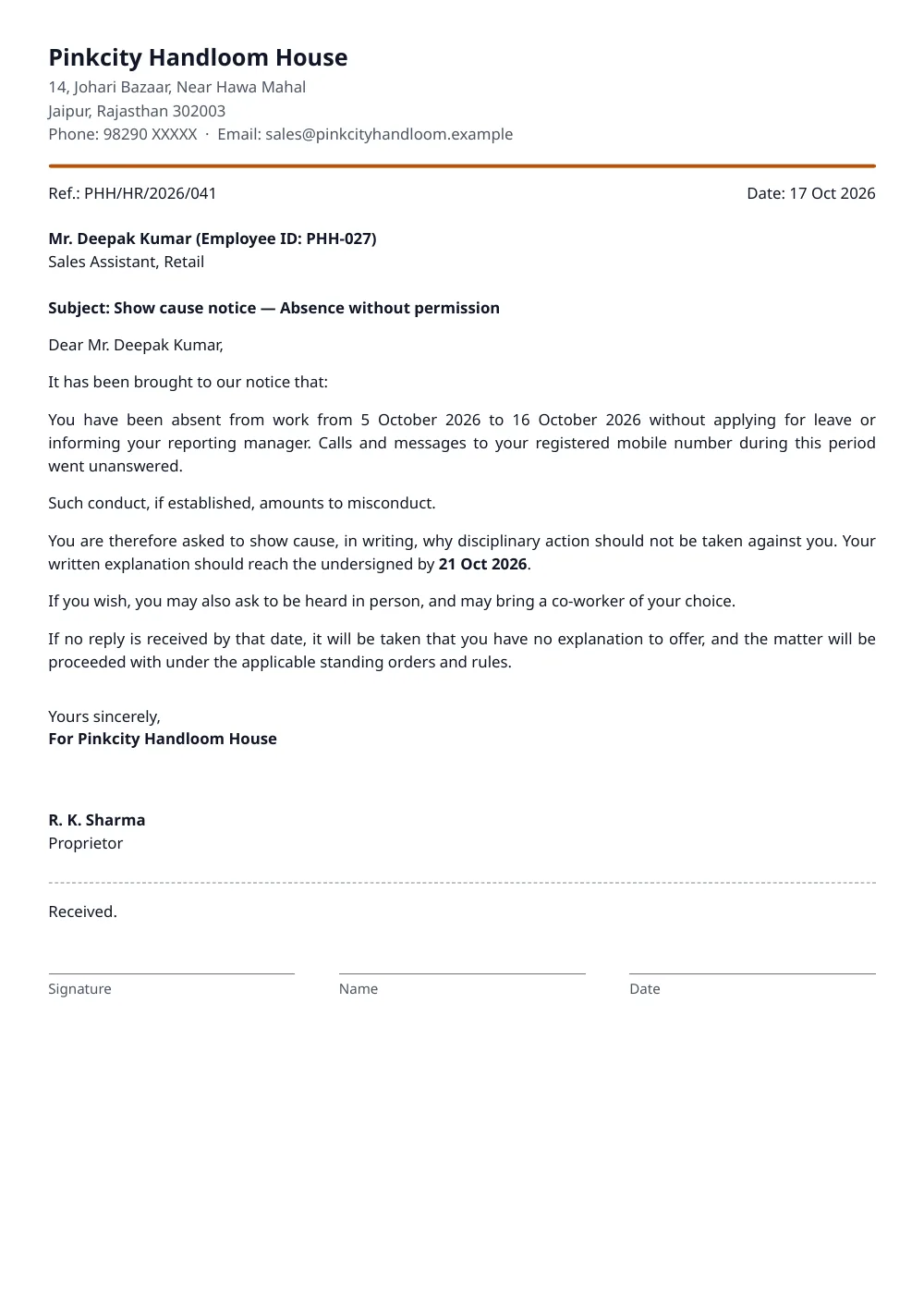
Made with the tool above from made-up details: every name and number in it is invented. Press “See a filled-in example” in the tool to open it there and download it.
What the notice says
- Who it is to: the employee’s name, ID, designation and department
- What is alleged, as facts: dates, times, places and what was done
- That such conduct, if established, amounts to misconduct, and the request to show cause in writing
- The date the written explanation must reach you, and to whom
- Optionally: a hearing in person with a co-worker, what happens if no reply comes, a reference to an earlier warning on the same matter, and a line for the employee to sign as received
Facts, not conclusions
Write what someone saw or what the records show: “absent from 5 to 16 October without leave or intimation”, not “careless and irresponsible”. A notice that states facts is one the employee can answer, and one that still reads fairly if it is ever put in front of an enquiry officer or a court.
After the reply
If the explanation is accepted, close the matter in writing. If it is not and the matter is a minor one, a warning letter records it. Anything heavier depends on the standing orders or service rules that apply: where the Model Standing Orders apply, an enquiry, and only then any penalty. Keep the notice, the reply and every date together on the employee’s file.
Sources
- Model Standing Orders, 2026, S.O. 2312(E) of 8 May 2026 (Gazette of India, Extraordinary, No. 2221), Schedule C (service sector), standing order 24; the same order in Schedules A and B, whose list of misconduct omits only the IT-access item
- Industrial Relations Code, 2020, sections 28 and 29(2)
Questions people ask
What is a show cause notice?
A written notice from the employer that sets out what is alleged against an employee and asks them to explain, in writing and by a date, why disciplinary action should not be taken. It comes before any decision: it gives the employee a fair chance to answer, and gives the employer a record that they were asked.
What should it say?
The facts, without opinions: what happened, when and where. Then the date by which the written explanation must reach you, and to whom. Optionally, an offer to be heard in person, and what happens if no reply comes. Signed by someone authorised, on letterhead.
What counts as misconduct?
Where the Model Standing Orders, 2026 apply, order 24(5) lists it. For the service sector (S.O. 2312(E) of 8 May 2026, Schedule C) the list includes theft, fraud or dishonesty in connection with the employer's business; wilful insubordination or disobedience of a lawful and reasonable order of a superior (which should normally be in writing); habitual late attendance and habitual absence without leave; continuous absence without permission and without satisfactory cause for more than ten days; habitual neglect of work; disclosure of confidential information; a false bill for reimbursement; unauthorised access to the employer's, a customer's or a client's IT systems; and sexual harassment. "Habitual" means misconduct three or more times in the preceding twelve months.
Do the Model Standing Orders apply to my business?
The Industrial Relations Code's chapter on standing orders applies to an industrial establishment in which 300 or more workers are employed, or were employed on any day of the preceding twelve months (section 28), and there the model standing orders are deemed adopted until the establishment's own are certified (section 29(2)). They speak of workers, which leaves out people employed mainly in a managerial or administrative capacity. A smaller business follows its own rules and the appointment letter; asking for an explanation before acting is good practice everywhere.
Can the employee be punished straight after the notice?
Not where the Model Standing Orders apply. A penalty (dismissal, suspension, a fine, stoppage of an annual increment or reduction in rank) comes after an enquiry, once the worker has been found guilty and given a reasonable opportunity of making representation on the penalty proposed (order 24(6)(f)). The enquiry is to be completed within ninety days, extendable for reasons recorded in writing (24(6)(e)), and the worker can appeal within twenty-one days of the order (24(8)). The notice itself decides nothing.
How long should the employee get to reply?
The orders do not fix a time for the reply to a notice. Give a reasonable time, and state the date in the notice rather than a number of days, so there is no argument about when the time runs out.
What if the employee refuses to accept the notice?
Where the Model Standing Orders apply, refusing to accept a charge-sheet, order or notice communicated in writing is itself listed as misconduct (order 24(5)(t)). Note the refusal, the date and who was present, and send the notice by another route too, such as email or registered post, so there is a record that it was sent.
Can the notice be in Hindi?
Yes. Switch Document language to हिंदी above the preview and the whole notice is worded in Hindi. Where the Model Standing Orders apply, the enquiry itself is recorded in Hindi, English or the language of the State, whichever the worker prefers (order 24(6)(d)), so a notice in the language the employee reads is a sensible start.
Can the employee be suspended?
Where the Model Standing Orders apply, a worker may be suspended pending an investigation or enquiry, by an order in writing, with a statement of reasons within a week. Subsistence allowance is fifty per cent of the wages last drawn for the first ninety days, and seventy-five per cent after that if the delay is not the worker's doing (order 24(1)-(4), (6)). This tool does not make a suspension order; it is only the notice asking for an explanation.
Can I download it in Word, or get a blank format?
Yes. Press Word (.docx) above the preview for an editable file, or 'Blank format' for one to fill in by hand. The blank PDF and Word files are also linked at the top of this page.
Last reviewed: 23 October 2026