
How to use it
- 1Enter your name, address and PAN, and the category of exporter your bank asks for. They are saved on your device for next time.
- 2Add your bank branch and its AD code: the branch where the foreign payments arrive.
- 3List the month's invoices: who the client is, the country, the invoice number and date, the currency and the amount. One EDF can cover every client of the month.
- 4Fill in the total value in rupees and a short description of the services, then answer the declaration questions: who is declaring, who pays, and the date by which the full value will be received.
- 5Check the preview and press Download PDF / Print, or Word (.docx) to edit it further. Ask your bank how it wants the form: at the branch, by email or through net banking.
EDF Form for Export of Services – a filled-in sample
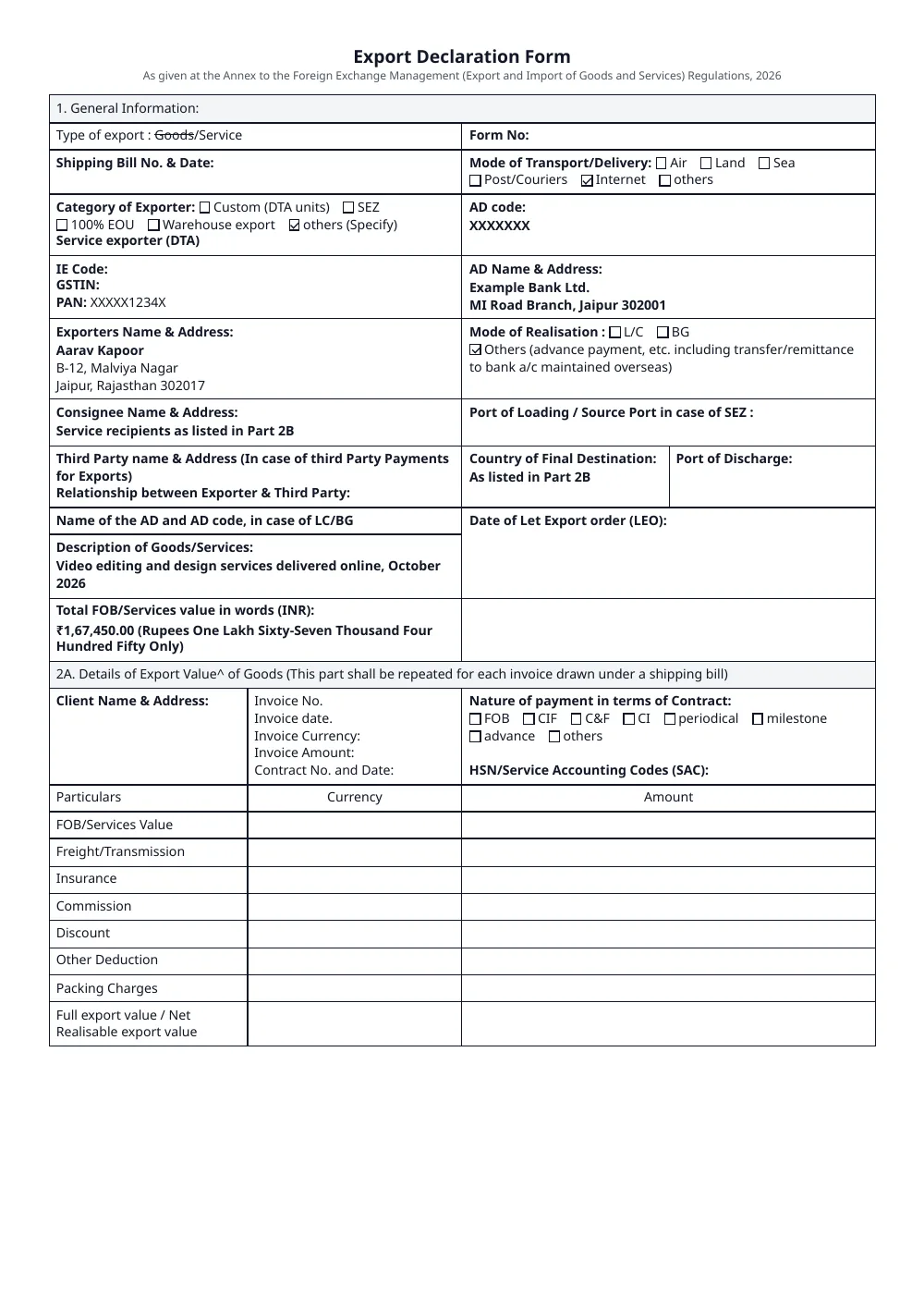
Made with the tool above from made-up details: every name and number in it is invented. Press “See a filled-in example” in the tool to open it there and download it.
Individuals: what RBI said on 7 October
The Regulations say an exporter of services files an EDF, and freelancers and creators asked whether that meant them. RBI answered at its post-policy press conference on 7 October 2026. Governor Sanjay Malhotra said individuals providing services abroad, such as tutoring or small software work, and getting paid for it, are not required to report. Deputy Governor Rohit Jain said individuals are not included in the reporting requirements for contracts of a personal nature. RBI will issue FAQs to settle the scope, and the Regulations’ text has not changed. Until the FAQs are out, if you earn as an individual, ask your bank before you file. Firms and companies that export services file the EDF as this page describes.
The form exactly as RBI gives it
RBI’s EDF is one form for goods and services, and many of its boxes are about shipping: the shipping bill, the port of loading, the date of the Let Export Order. An exporter of services leaves those empty. This format keeps every box and every word of RBI’s Annex in place, so your bank sees the form it knows, and fills in the parts that apply to services: Part 1, the services table in Part 2B, and the declaration in Part 4.
One form for the whole month
You do not need a form for every invoice. Regulation 3(2)(a) lets you put every service export of a month on a single EDF, however many clients there were. List each invoice once and it goes into Part 2B with the client, the country, the invoice number and date, the currency and the amount. With one client, its name also goes into the consignee box in Part 1; with several, that box points to Part 2B. If your bank wants it worded differently, change it in the Word file.
The invoices come first. Our export invoice prints the endorsement rule 46 of the CGST Rules asks for, under LUT or with IGST, the client’s country and currency, and the rupee value, so each one is ready to list here.
Two dates to keep track of
The first is the filing date. The EDF is due within 30 days from the end of the month in which the invoice was raised, so October’s invoices are due by 30 November and November’s by 30 December. The second is the payment. The full value has to arrive within nine months of the invoice date, or twelve if you invoice in rupees, and the declaration asks you to state that date. The summary under the form works out both from your invoice dates.
What your bank decides
RBI sets the rule and the form. Your bank decides how it takes the EDF, what it wants with it and, for a business paid by a platform like YouTube or AdSense, which pays on its own statements rather than against your invoice, what it accepts as the invoice reference. Ask your branch once, before the first filing, and you will know for every month after that.
For the whole picture, including who has to file, the deadlines and the ₹10 lakh closure declaration, read our guide to the EDF for export of services.
Sources
- Foreign Exchange Management (Export and Import of Goods and Services) Regulations, 2026, Notification No. FEMA 23(R)/2026-RB, 13 January 2026, as amended on 22 September 2026
- The Export Declaration Form, Annex to the Regulations (PDF)
- RBI Directions on Export and Import of Goods and Services, A.P. (DIR Series) Circular No. 20, 16 January 2026
- RBI’s statement on the feedback received (PDF), annex to Press Release 2025-2026/1933, 16 January 2026
- RBI clears the air on new forex reporting rules: Framework does not apply to individuals, BusinessToday, 7 October 2026: the Deputy Governor’s and the Governor’s remarks at the post-policy press conference
- Personal service transactions need no reporting under new forex rules, Business Standard, 7 October 2026
Questions people ask
What is the EDF form?
The Export Declaration Form is the form on which an exporter declares the full value of an export to the 'specified authority'. RBI gives it at the Annex to the Foreign Exchange Management (Export and Import of Goods and Services) Regulations, 2026 (Notification No. FEMA 23(R)/2026-RB of 13 January 2026), which came into force on 1 October 2026. It is one form for goods and services. For services, the specified authority is the Authorised Dealer, meaning your bank, or for software the bank or STPI; for a unit in an SEZ it is the zone's Development Commissioner.
What is the full form of EDF?
Export Declaration Form. Under RBI's Foreign Exchange Management (Export and Import of Goods and Services) Regulations, 2026 it is the one form on which exports of goods, services and software are declared, and for software it takes the place of the old SOFTEX form.
Is the EDF compulsory for exporters of services?
Regulation 3(2) says an exporter of services 'shall furnish' a declaration in EDF to the specified authority. When people asked RBI to exempt service exports, it replied 'Not accepted. Section 7 of FEMA, 1999, makes declaration of exports mandatory', and made the process and timeframe more flexible instead. For individuals, see the next answer: on 7 October 2026, RBI said those providing services abroad are not required to report.
I'm an individual freelancer or creator paid from abroad. Do I have to file?
What RBI said on 7 October 2026 points to no. At the post-policy press conference, Governor Sanjay Malhotra said individuals providing services abroad, such as tutoring or small software work, and getting paid for it, are not required to report, and Deputy Governor Rohit Jain said individuals are not included in the reporting requirements for contracts of a personal nature (as reported by BusinessToday and Business Standard). RBI said it will issue FAQs, and the Regulations' text has not changed. Neither official named YouTube or AdSense, so until the FAQs are out, ask your bank before filing anything. A firm or company paid by foreign clients or by a platform is an exporter of services, and the rest of this page applies to it.
When do I have to file the EDF?
Within 30 days from the end of the month in which the invoice was raised (Regulation 3(2)). Invoices raised in October 2026 are due by 30 November 2026, November's by 30 December 2026 and December's by 30 January 2027. For services other than software, the Regulation also lets you submit the EDF 'on or before the date of receipt of payment', and the bank can extend the period if you ask it, giving reasons for the delay.
Can one EDF cover several clients?
Yes. Under Regulation 3(2)(a), an exporter who has exported services to one or more recipients in a month 'may submit a single EDF for all such exports'. That is what Part 2B of the form is for: one row per invoice. Add each of the month's invoices here and they go into that table in order.
Which parts of the form does an exporter of services fill?
Part 1 (general information), Part 2B (the services table) and Part 4 (the declaration). Part 2A is for goods, Part 3 is for exports through the post or a courier, and Part 5 is for the bank. This format keeps all five parts as they are in RBI's Annex and leaves the goods boxes empty.
What does 'strike out whichever is not applicable' mean?
The declaration is written for every kind of exporter at once: 'I/We', 'buyer/third party', 'foreign exchange/Indian Rupees', 'goods/services'. You strike out the words that do not apply to you. Answer the questions in the Declaration section and the words are struck out for you, in the PDF and in the Word file.
By when must the payment arrive?
Regulation 5(1)(a) gives nine months from the date of invoice for services, or twelve months where the export is invoiced or settled in Indian rupees. The nine months came in by an amendment of 22 September 2026; it was fifteen months before. If a client pays late, the bank may extend the period on your request, if it is satisfied with the reasons. The declaration asks you for the date, and the summary under the form works it out from your earliest invoice.
What is the AD code, and where do I get it?
AD stands for Authorised Dealer: the bank authorised to deal in foreign exchange, where your foreign payments arrive. The AD code is that bank branch's code, and the branch can give it to you. The form asks for the bank's name, address and AD code.
What about invoices of up to ₹10 lakh?
Under Regulation 4(2), for an invoice of up to ₹10 lakh (or its equivalent in foreign currency) the bank may close its EDPMS entry on your declaration that the payment has been realised, in full or otherwise, and you may give that declaration quarterly for many invoices at once. It is a separate declaration from the EDF; ask your bank how it wants it.
Is this the same as SOFTEX?
SOFTEX was the separate form for software exports under the 2015 Regulations. The 2026 Regulations have one declaration form, the EDF, and name the bank or STPI as the specified authority for software, so software exports are declared on the EDF too.
Does the EDF change my GST or income tax?
No. The EDF is a declaration under the foreign exchange law, FEMA. Income tax and GST have their own rules and returns, and filing an EDF does not change them.
How do I file the EDF?
RBI sets the rule and the form; each bank decides how it takes it (at the branch, by email or through net banking) and what goes with it. In its statement on feedback, RBI said banks 'can handle transactions as per their internal policy', and Regulation 19 requires each bank to publish the main features of that policy, with its documents, timelines and charges, on its website. Look there, or ask your branch. Once the bank has your EDF, Regulation 18 gives it five working days to enter it in EDPMS, the Export Data Processing and Monitoring System.
Where can I download the blank EDF form PDF?
At the top of this page: the blank EDF as a PDF to print and fill by hand, and as a Word file to type into. It is the form RBI gives at the Annex to the Foreign Exchange Management (Export and Import of Goods and Services) Regulations, 2026, with every box and every word in place. RBI's own copy of the Annex is at https://rbidocs.rbi.org.in/rdocs/content/pdfs/NRAR23R16012026_AN.pdf if you want to compare.
Do SBI, HDFC, Canara Bank and other banks have their own EDF form?
The EDF itself is one form: regulation 2(1)(c) defines it as 'the form given at Annex', and this page reproduces that form. What differs from bank to bank is how they take it. RBI left the handling to each bank's internal policy, and regulation 19 requires every bank to publish the main features of that policy, with its documents, timelines and charges, on its website. Some banks may also want a covering letter or a declaration of their own with the form, so check your bank's website or ask your branch.
Can I download the EDF format in Word?
Yes. Press Word (.docx) above the preview. You get the same form as the PDF, every box and word in place, ready to edit. It is a standard .docx file, the format used by Microsoft Word, Google Docs, WPS Office and LibreOffice. A blank EDF in Word, with nothing filled in or struck out, is linked at the top of this page.
Is there a blank EDF format to fill by hand?
Yes. Press 'Blank format' for an empty EDF to print and fill with a pen, with room in the boxes and eight empty rows in the services table, or use the blank PDF and Word files linked at the top of this page.
Can the form be in Hindi?
RBI gives the form in English, so it prints in English, as banks expect it. The questions on this page are also in Hindi: switch the site language to हिंदी at the top.
Last reviewed: 14 October 2026