
An experience letter is the employer’s written record of what someone did there: the job, the dates, and the work. Years later it is often the only proof a person has, because the colleagues who knew them will have moved on. Most of what goes wrong with one is vagueness — “worked with us for about three years” — and the fix is simply to be exact.
Experience letter or experience certificate?
The same document under two names. “Experience certificate” is the older form, usually headed “To whomsoever it may concern”; “experience letter” is sometimes written to the employee directly. Both certify the same facts, and either is accepted.
It is not the same as a relieving letter. A relieving letter confirms that someone’s resignation was accepted and that they were released on a given date; the next employer asks for it before joining. An experience letter certifies what they did. People leaving a job need both.
What an experience letter looks like
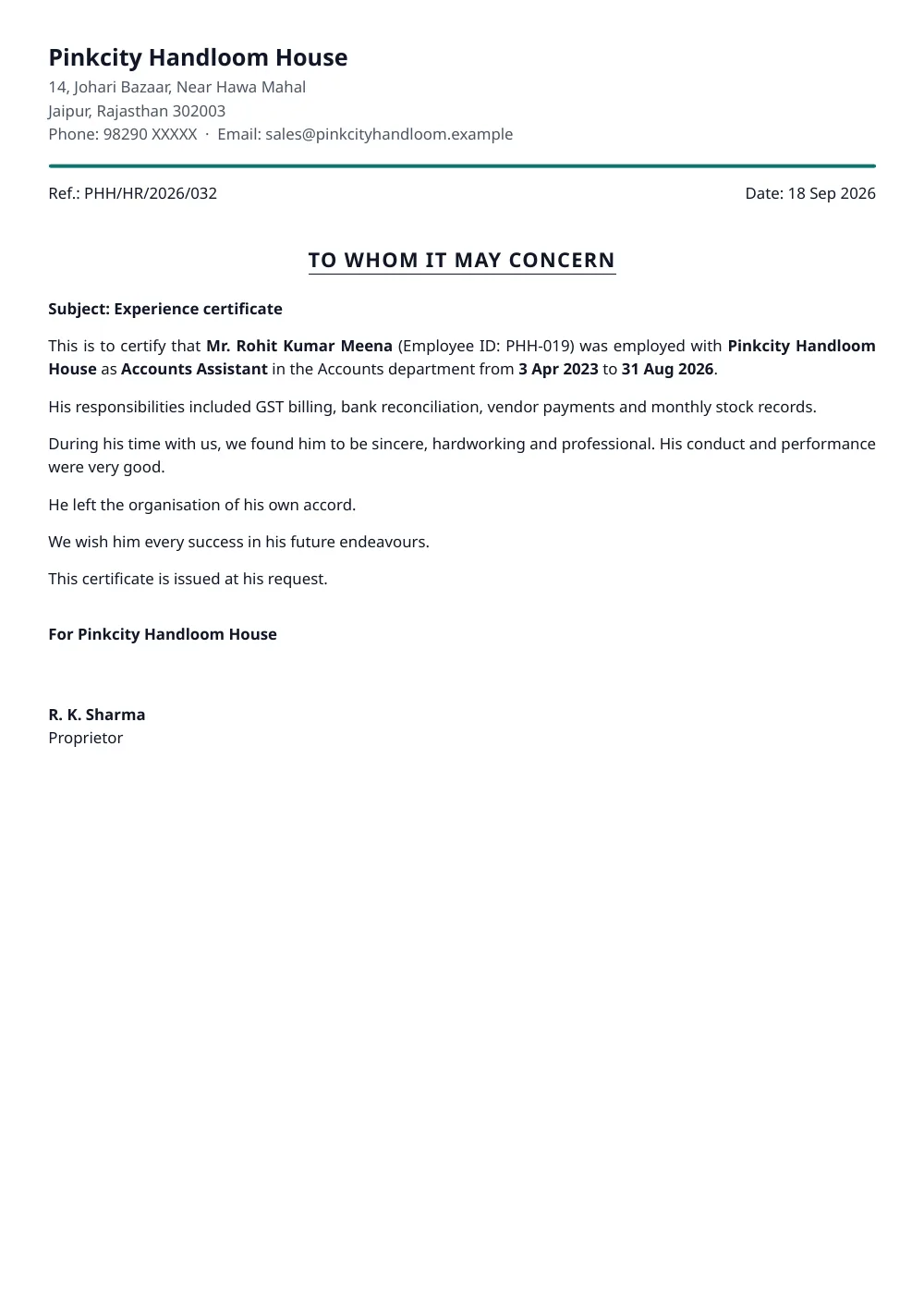
Here is one filled in. The names, the company and the dates are made up; the layout is a real one: the letterhead, a reference number and date, “To whom it may concern”, then the name, position, dates and duties, and an authorised signature at the foot.
What it should say
- Full name, exactly as in the employer’s records, with the employee ID if there is one.
- Designation. If the person was promoted, every designation held, each with its dates. Background checks compare titles, and a mismatch reads as a red flag.
- Department and, where useful, the location.
- Date of joining and last working day, as dates — not “about three years”.
- A short, factual description of the work: two or three lines on what the role involved.
- Signature of an authorised person, with their name and designation, on the business’s letterhead, with a date and a reference number.
A line on conduct (“we found her sincere and hardworking”) is common and fine — if it is true.
What to leave out
- Salary. Pay belongs in a salary certificate, which is issued for a purpose such as a bank loan.
- Reasons for leaving and anything about disputes. The letter will be shown to the next employer.
- Performance ratings and opinions beyond a line on conduct. If someone needs a recommendation, that is a reference letter, signed by a person who can vouch for them.
Who should sign it
Someone with the authority to certify employment and who can be reached later: the HR head or manager in a company, the proprietor or a partner in a smaller business. Background-verification agencies call or email the issuer to confirm the dates and the designation, so those two details must match what the employer’s records say.
Does it need a seal or stamp?
No law requires a seal or a rubber stamp on an experience letter. Even a company’s common seal has been optional since the Companies (Amendment) Act, 2015. What makes the letter credible is the letterhead, a real signature, and an issuer who answers when the verifier calls.
Still, many verifiers — background-check agencies, some embassies — expect a stamp beside the signature, and it costs nothing to add one. If your business has a stamp, use it.
When to ask for it
On the last working day, together with the relieving letter and the full and final settlement. Once someone has left, a letter takes weeks to arrive, if it arrives at all. The checklist of what to collect before leaving is in What to Collect Before Your Last Working Day. To ask in writing, with the relieving letter and the settlement in the same letter if you are leaving, use the application for experience certificate.
If you are writing one
Write in the past tense for someone who has left, state facts rather than praise, and do not overstate a title or a date — a verifier who finds one detail wrong stops trusting the rest. The experience letter format words it for you from the name, designation and dates, in English or Hindi, ready to sign as a PDF or to edit in Word.
Make it now
- Experience LetterExperience certificate on your letterhead, worded for you.
- Application for Experience CertificateAsk your employer for the experience certificate, and the relieving letter too.
- Relieving LetterResignation accepted, last working day, dues settled.
- Full and Final SettlementDues, recoveries and the net amount on the last working day.
Keep reading
- What to Collect Before Your Last Working DayPaperwork is far easier to get while you are still on the rolls. Here is the list, and what to do when something does not arrive.
- What Changed for Indian Employers on 1 April 2026Four changes landed at once, and most HR templates in circulation still predate all of them. Here is the list, with what each one actually requires.
- When You Need an NOC, and What to Put in ItAn NOC is a family of documents, not one. In two common cases the letter people write is not the document that was actually required.